Did you know...
THE MAYOR IS SUBJECT TO THE DIRECTION AND CONTROL OF COUNCIL...
I think it is important to be honest and upfront with the public. Any candidate running for the position of Mayor should not make grand promises because a Mayor has no ability to deliver on those promises since the power of the Municipality is vested in its Council and it is the Councillors that pass bylaws, set policy and determine the budget and tax rate. The Local Governance Act stipulates that the Mayor is subject to the direction and control of Council and shall abide by the decisions of Council. The Councillors are the representatives of the people and it is the Council as a whole that make the decisions.
Notwithstanding this, the mayor plays an important role in local government by:
- providing leadership to Council
- acting as the spokesperson for the Town and Council in all matters
- communicating and providing recommendations to Council
- presiding over Council meetings in a role similar to the Speaker of the House of Commons
- ensuring that Council has accurate, timely and relevant information to make well informed decisions
- providing a linkage between staff and Council to ensure that Town is operating effectively
- promoting public participation in the democratic process
POLICE SERVICES...
St Andrews is one of 7 communities in New Brunswick with a Municipal Police Services Agreement. This agreement with the federal government specifies that five police officers and a clerk are to work in St Andrews. The RCMP uses the resources from the St Andrews contract to augment policing on the Provincial Police Services contract. This means that police officers who, by contract, should be working in St Andrews are employed elsewhere in Charlotte County which is wrong. |
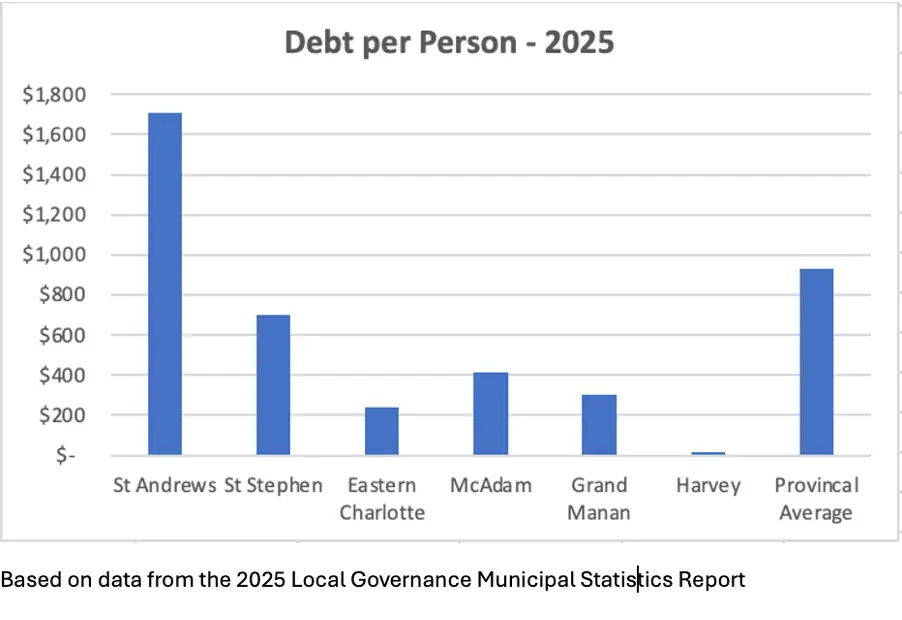
EVER INCREASING DEBT...
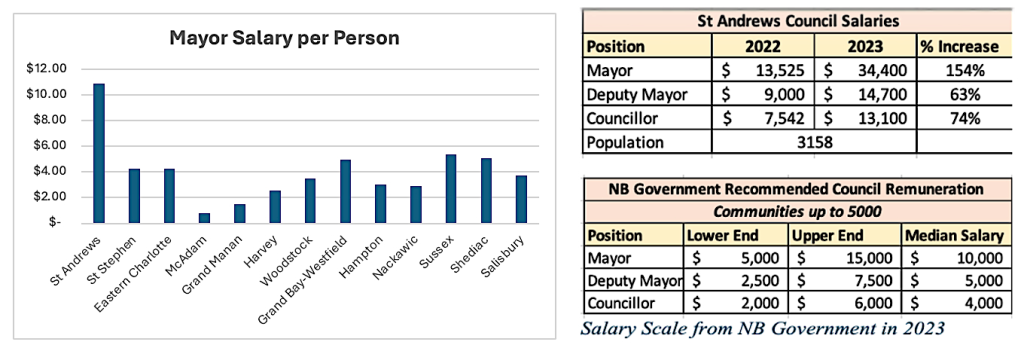
COUNCIL PAY INCREASE...
PROPERTY RIGHTS...
MUNICIPAL PLAN AND ZONING BYLAWS...
The proposed Municipal Plan and Zoning bylaws are complicated documents and do not reflect community values. These documents were done with little public consultation, advocate for densification of the National Historic Site (Town Plat), allow a multitude of new institutional uses, create new rules for rural residents, disregard the rights of existing property owners and threatens the very fabric of Saint Andrews.
These are important bylaws that have a big impact on how people can use their property, what development can occur on adjacent properties, the quiet enjoyment of their homes and the general look and feel of our Town. The public has a right to have full input and a right to be heard which has not yet happened…
The deadline for completion of these plans is 1 January 2028, so why the rush.
TRANSPARENCY AND OPENESS...
Transparency and openness are a key elements in Municipal Governments and are an essential part of a good governance framework. Transparency requires that information be shared openly with the public, decision-making processes are clearly understood, there are clear communications with stakeholders, public participation is encouraged and public feedback is valued.
In the last two years there have been 17 Council meetings closed to the public in violation of the Local Governance Act. At meetings, Council has moved into closed session and excluded the public over 95 times which seems excessive. Motions are often passed with no debate, no discussion and no indication of why the Councillors are voting for the motion which leaves the public in the dark. This gives the appearance that the motion has been discussed previously and the outcome of the public vote has been pre-determined.
PROPERTY TAXES...
Residental property revenues in the town portion of Saint Andrews have increased by 32% since 2022 while the tax rate has only decreased by 12%. Similarly in Bayside and Chamcook, residential property values have increased by 27.5% since 2023 while the tax rate has only decreased by 3%. This indicates that assessments across the board are rising faster than tax rate decreases which leads to higher property taxes.
This trend is expected to continue and the recent double digit assessment increases for 2026 assessments indicate a potential problem ahead. Although the 2026 assessments have been frozen this year for most people, the 2026 increased assessments added to the 2027 assessment increases could lead to significant property tax increases in 2027 and beyond. Measures need to be put in place to protect the public from assessment driven tax increases.
The property tax payable is determined using the following formula:
Tax Payable = Assessed Value ÷ 100 x Tax Rate
The Town has no control over the Assessed Value which is done by the Province but the Town has full control over the Tax Rate which can be reduced to offset any assessment driven tax increases. Generally speaking, this means that if the average Assessed Value goes up by 15% then the Tax Rate should be decreased by 15% to maintain the Tax Payable at about the same level.
THE HIDDEN INFRASTRUCTURE CRISIS...
A key responsibility of the Town is to provide and maintain municipal infrastructure needed to deliver municipal services to the public. Much of this infrastructure is in dire need of upgrading or replacement and as recent events in Calgary and Montreal have shown, they can fail catastrophically with dire consequences.
There is a significant backlog of work to replace and repair Town public infrastructure (roads, wharf, buildings, dam, fire protection systems, town vehicles, recreational facilities, water and sewer systems, etc…) deemed to be in “poor” or “very poor” condition that is estimated to be in the millions of dollars. This problem is not unique to Saint Andrews, in 2020, Statistics Canada stated that this infrastructure backlog across Canada was equivalent to $16,252 per private dwelling. Even more concerning, is that there are millions more dollars that may be required to replace public infrastructure where the condition is unknown.
Talking about this infrastructure backlog is not politically attractive, so the backlog often gets ignored … but ignoring a problem does not make go away. The only way to address the infrastructure backlog and leave our children and grandchildren with a lasting legacy is to get ahead of the problem by developing a long-term asset management plan with the proper tools, training and systems implemented by Council and Staff working together.
This will require leadership that has the education, experience and background in asset management principles and practices to guide the Town to the next level and position Saint Andrews as a leader in asset management in New Brunswick.
HERITAGE MATTERS...
A National Historic Site is something very special, there are only 1009 National Historic Sites in Canada of which Saint Andrews is one. During my tenure as the Chief of Asset Management Services at Parks Canada, I was involved in setting the policy for the maintenance, rehabilitation and recapitalization of 171 of these National Historic Sites administered by Parks Canada. It was a responsibility that I took extremely seriously along with the Parks Canada commitment “To protect as a first priority, the natural and cultural heritage of our spacial places and ensure that they remain healthy and whole.”
As a community, we cannot allow short sighted policy decisions to threaten our built heritage and the historic character of Saint Andrews. The heritage and quaint small town feel has played a significant role in people’s choice of living in Saint Andrews which would be lost if we do not take steps to protect our heritage. Saint Andrews has long been recognized as a special place both nationally and internationally for its historic character, but all this could fade away if the National Historic District is populated with infill developments of 4 unit and 8 unit apartments and open spaces paved as parking lots.
Heritage is a fragile thing and is lost one building and one property at a time and once it is gone, it is gone forever. There are already pressures on key heritage assets such as Sherriff Andrews House, the Courthouse and Greenock Church that need to be addressed. These assets are central to the identity of our Town and how we protect and cherish these heritage icons will define us a Town. Now is the time to rise up as a community and show that heritage is important not just for the present but future generations.
We cannot, as a community, afford to lose the heritage assets which we hold in trust…heritage matters